
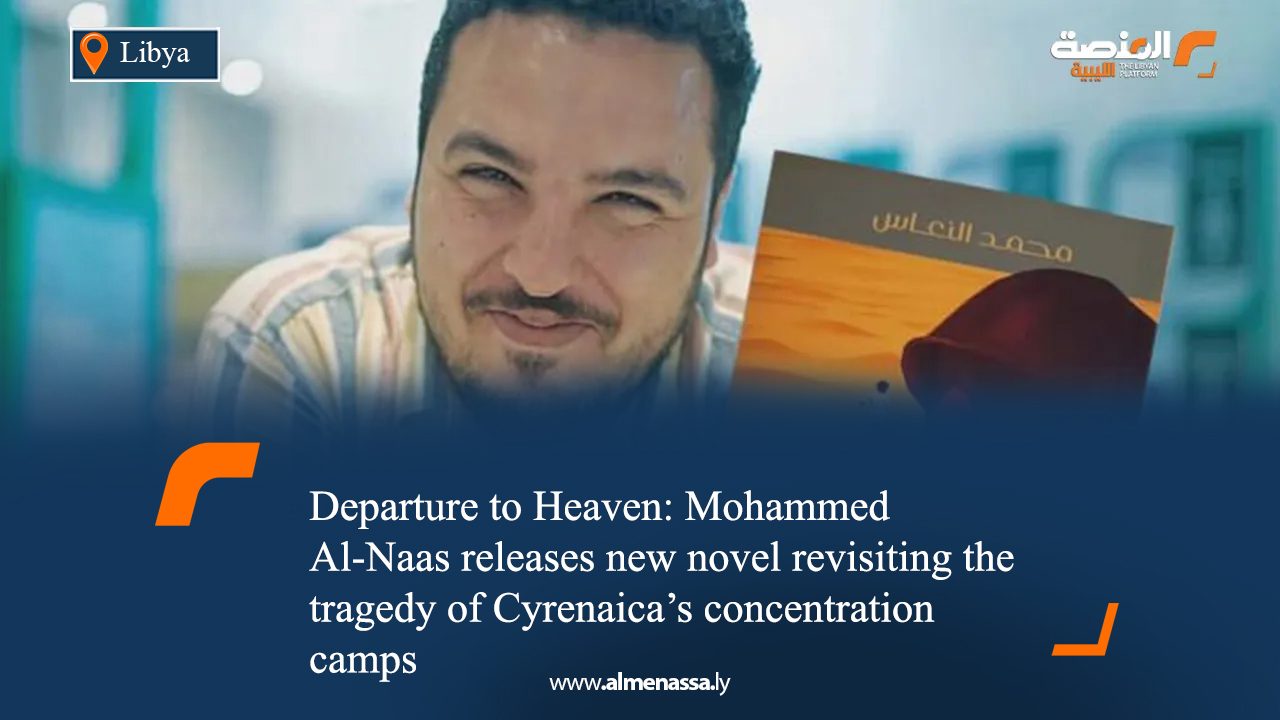
The Libyan novelist Mohammed Al-Naas has released his third novel, Departure to Heaven, published by Dar Al-Ferjani in Cairo. This latest work follows his acclaimed novels Brawl in Hell and Bread on Uncle Milad’s Table, which won the International Prize for Arabic Fiction (IPAF) in 2022.
In an extensive post on his personal page, Al-Naas explained that the novel follows the journey of a child named Jaballah, who is caught up in the ethnic cleansing campaigns orchestrated by Italian colonialism in Cyrenaica during the late 1920s and early 1930s—a period marked by the death of nearly 100,000 Libyans in fascist concentration camps. The narrative centres on a poignant existential question regarding the fate of a child who believes his family is travelling to “Heaven,” in a journey where innocence is shadowed by death and loss.
The author noted that the novel draws inspiration from the poetry of the late Libyan poet Rajab Buhuwaysh on the concentration camps and relies on Dr. Ali Abdullatif Ahmida’s Genocide in Libya as a primary academic reference. Al-Naas described the work as a confrontation with the “policies of forgetting” that have obscured Italian colonial crimes in Libya.
Al-Naas revealed that the writing process was difficult and intermittent, regaining momentum following the events of October 7, 2023. Influenced by the birth of his son and the resurgence of global tragedies, he completed the text as an act of resistance against oblivion. He credited Dar Al-Ferjani and several writers and friends for their support in editing the manuscript, as well as the artist Yassin Al-Swayeh for the cover design.
The release follows an announcement by Dar Al-Ferjani last August, when Director Ghassan Al-Ferjani signed the publishing contract with the author. The publishing house described the novel as a qualitative addition to the Arab literary scene. According to the author, Departure to Heaven serves as a new literary testimony to one of the harshest chapters of modern Libyan history, asserting that literature remains a sanctuary for both memory and art, and a means to keep the past alive in the collective consciousness