
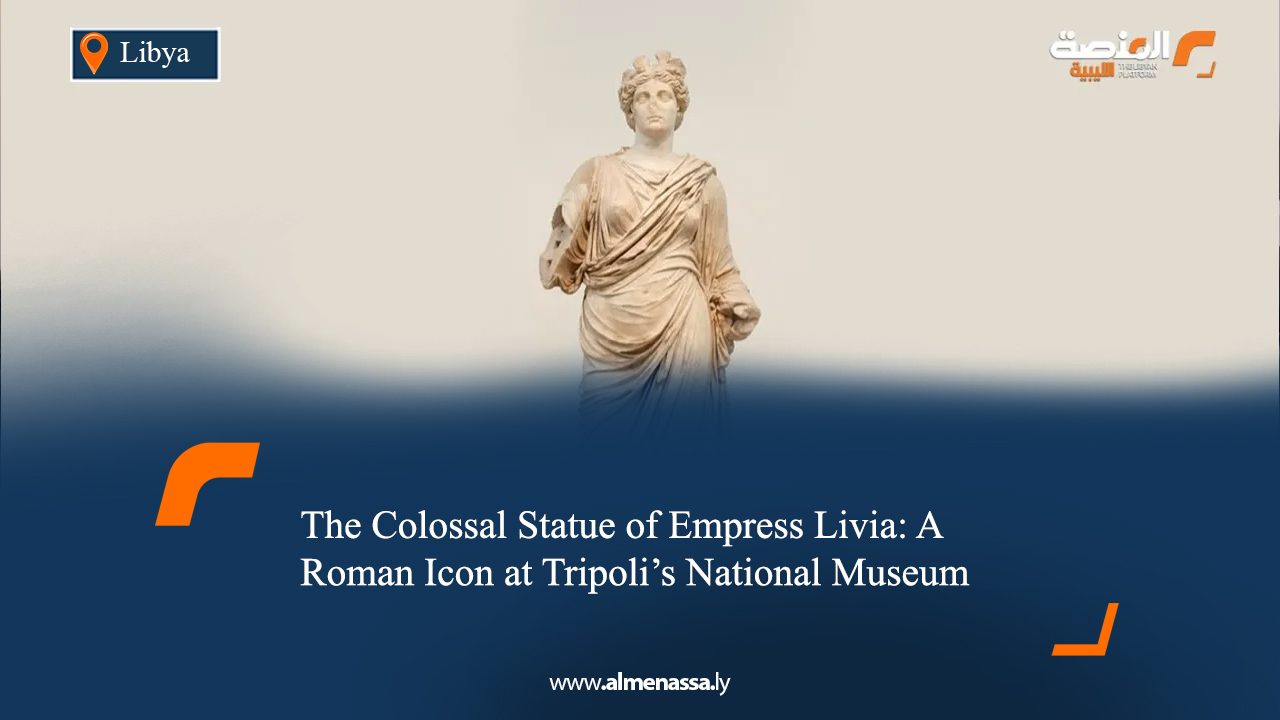
Sculpted from fine Pentelic marble, this 3.10-meter-tall statue represents a distinct example of “colossal sculpture” in Roman art. Discovered in Leptis Magna in 1938, the statue depicts Livia in a dual form, merging the goddesses Ceres and Tyche, representing a clear example of religious and political syncretism in the early Roman era.
Recovering 20 Stolen Artifacts in Joint Operation
The statue was found in the theatre of Leptis Magna, situated in a small temple atop the seating tiers before the building collapsed, shattering the statue into hundreds of fragments, some found in the orchestra and others in the adjacent street. Despite restoration efforts, it still lacks hands and other parts, with visible damage to the nose, upper lip, and turreted crown. It was executed using separate cuts, with iron clamps used to secure the parts; drill marks are prominent in the hair, and chisel marks appear in the heavy folds of the clothing.
The Gladiators Mosaic at the Leptis Magna Museum.. a journey through time
Artistically, the statue follows the “Core del Vaticano” model, influenced by the Greek school and the style of the sculptor Praxiteles, yet featuring distinct Roman characteristics manifest in the severity and relative rigidity of the clothing folds. The face displays strong imperial features and Livia’s signature “nodus” hairstyle, which helped confirm her identity through comparison with other known statues of her.
Religiously and politically, the statue embodies Livia as the priestess of the deified Augustus, through Tyche’s symbols, such as the turreted crown, and Ceres’ symbols, like the wreath of wheat ears and poppies, while it is assumed she held the cornucopia and a ship’s rudder. The statue dates back to the late reign of Emperor Tiberius (35–36 AD), based on an inscription referring to a dedication by Governor Rubellius Blandus to “Ceres Augusta,” reinforcing the statue’s status as a unique artistic and historical document in Libyan and Roman heritage.
In a Facebook post, Khaled Al-Haddar, an archaeology professor at Benghazi University, noted that this sculpture has consistently captured his attention during his numerous visits to the museum since its initial opening in 1988, due to its exceptional scale and high skill in execution, despite being displayed in a narrow corner. It stands as one of the largest and most significant Roman sculptures displayed in the National Museum of Tripoli, regaining prominent attention upon the museum’s reopening on December 12, 2025.