
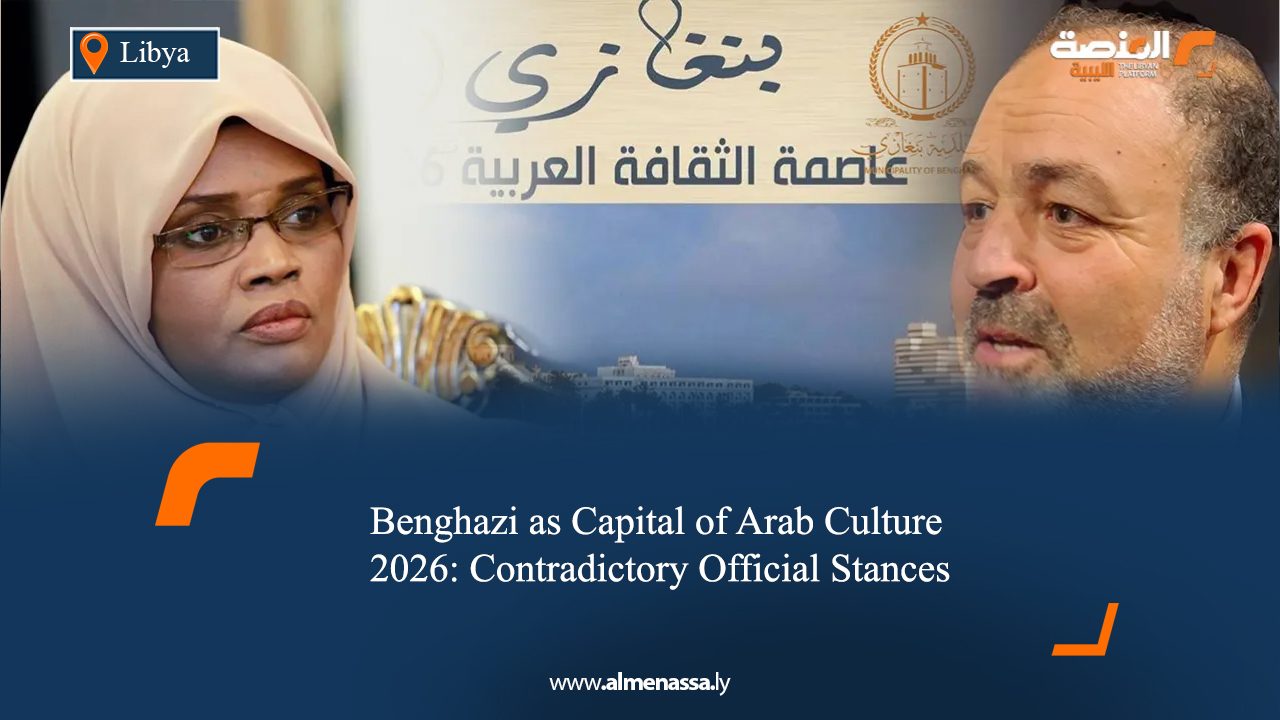
The Libyan scene has recently witnessed a sharp debate and widespread controversy following reports of an official correspondence sent by the Minister of Culture and Knowledge Development in the Government of National Unity, Mabrouka Togui Osman, to the Arab League Educational, Cultural and Scientific Organization (ALECSO). The letter directly requested that Benghazi be exempted from hosting the “Capital of Arab Culture 2026” events. The Minister justified this request by citing the need to consider current circumstances in the country and the necessity to focus national efforts on the national reconciliation file, noting the city’s logistical and technical unreadiness at the moment, and the conflict of the proposed date with other government obligations. This request sparked widespread resentment and a storm of criticism in cultural and media circles, as well as among Libyan activists, who viewed the move as an unfortunate retreat from a significant national and historical entitlement for the city, and a blatant undermining of efforts to showcase Libya’s cultural face to the Arab and international world.
Libya Participates in Arab Culture Ministers Conference in Rabat
In the context of angry and condemnatory reactions, the head of the Journalists’ Syndicate in Tripoli, Mansour Al-Ahrash, launched a fierce and direct attack on the minister via his personal social media account, describing her position as driven by unprofessional motives. He emphasized that Benghazi, with its cultural weight, symbolic value, and ancient history, is more than worthy of this major Arab title, and that this attempt reflects a narrow perspective in dealing with major cultural milestones that transcend narrow political calculations. Al-Ahrash considered the attempt to postpone or cancel the event an insult to the city’s civilization status, questioning the ministry’s competence in managing such sovereign files that are supposed to unite Libyans rather than divide them, especially given the challenges the country faces that necessitate uniting efforts rather than dispersing them, demanding high-level authorities to intervene quickly to ensure this event is held in Benghazi.
Libyan Ministry of Culture Launches Leadership Program for Creative and Cultural Industries
On its part, the Ministry of Culture and Knowledge Development hurried to issue a detailed clarifying statement, refuting what it described as allegations and rumors regarding the “cancellation” of the event completely. The ministry reaffirmed Libya’s full commitment to organizing the celebration on its scheduled date in 2026, based on previous official resolutions taken in meetings of Arab culture ministers and organization conferences. The ministry explained that the minister’s absence from the flag-handover ceremony in Kuwait was due to purely administrative hurdles regarding travel permits, not a dismissal of the occasion or a desire to evade it, emphasizing that work is underway to prepare the necessary cultural infrastructure and public facilities to ensure the success of this major Arab event and showcase it worthily.
In parallel, the Municipality of Benghazi entered the fray with an official and strong welcoming statement, stressing the city’s high organizational capabilities proven in the past when hosting major events. The municipality called on the Prime Minister to form a supreme committee for direct supervision of preparations, to ensure the celebration reflects Libya’s standing, away from narrow political maneuvers, ensuring that culture remains a bridge for communication and national unity. The municipality demanded the allocation of an exceptional and urgent budget to prepare cultural facilities and public places, emphasizing that the success of this entitlement is a matter of national honor and non-negotiable, and that Benghazi is ready to welcome the Arab brothers.