
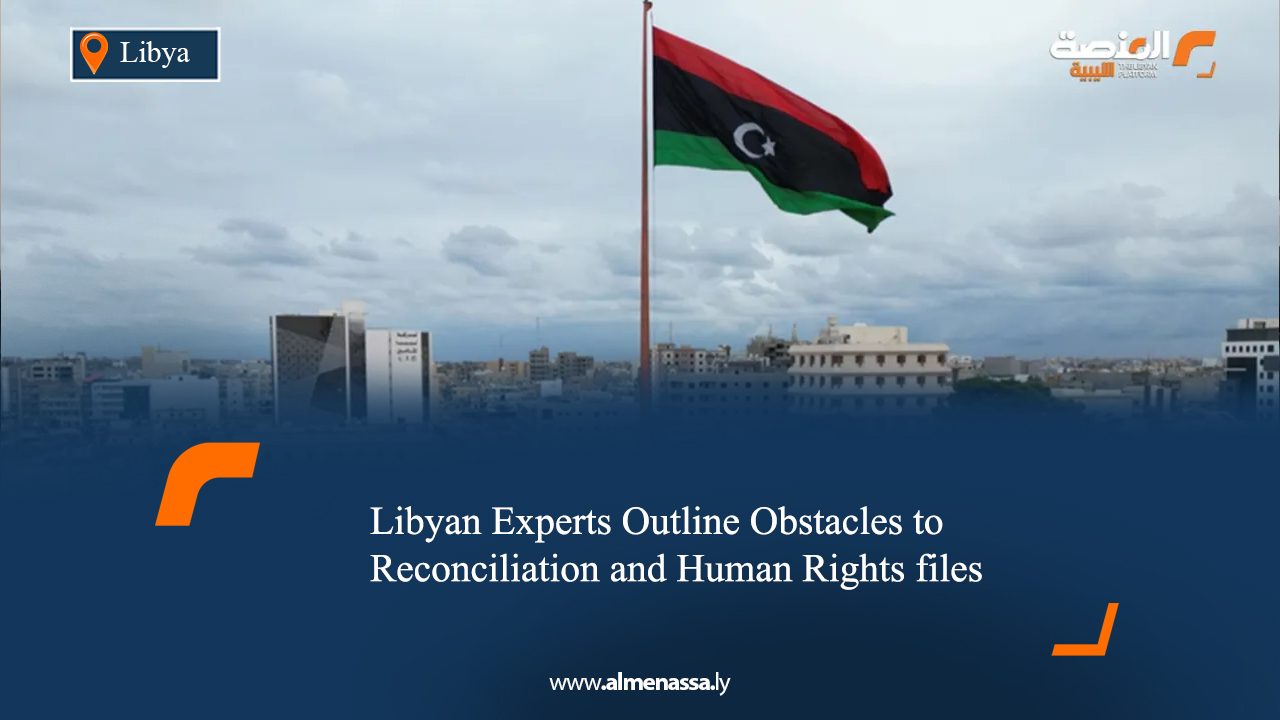
Amidst the intricacies of the Libyan landscape, characterised by over a decade of political division, security lapses, and accumulated violations, calls are intensifying to prioritise national reconciliation and human rights. These paths are viewed as essential gateways to achieving sustainable peace and stability. While Libyans hope to move past the era of conflict, victims continue to demand truth, justice, and reparations. This has sparked debate on balancing reconciliation with transitional justice, and on the United Nations’ role in integrating these elements into a framework tailored to Libya’s unique reality.
Opinions vary on this trajectory. Some perceive structured human rights dialogues as an opportunity to refine accountability mechanisms, while others caution against a deficient reconciliation process that might inadvertently perpetuate the crisis. Meanwhile, national and social entities assert that reconciliation is an indispensable sovereign choice and a state project that must remain untainted by political exploitation or exclusion. “Almanassa” consulted several human rights experts to explore the prospects and challenges of this national endeavour aimed at building a state governed by the rule of law.
UK urges Libya to issue legislation for safety, reconciliation, and women’s protection
Heated debates in Geneva on Libya highlight lack of accountability and political deadlock
Ahmad Hamza: Prioritizing Victim Rights and Systemic Reform
Ahmad Hamza, Chairman of the National Institution for Human Rights in Libya (NIHRL), emphasised that integrating human rights into structured dialogues can enhance how the current and future human rights situation is managed. In a statement to “Almanassa,” Hamza noted that this approach aligns with the aspirations of Libyans for national reconciliation and transitional justice. Such a process must be rooted in guaranteeing the rights of victims, providing compensation, and resolving the cases of those arbitrarily detained or held as political prisoners.
Hamza added that the current phase demands serious efforts to produce recommendations addressing priority issues. He argued that addressing the fallout of security chaos, the proliferation of armed groups, and crimes such as forced displacement is fundamental to achieving social peace. He expressed hope that these human rights tracks would lead to improved performance by authorities and a more effective handling of these files in accordance with the country’s urgent needs.
Abdel Moneim Al-Hurr: Cautious Optimism
Abdel Moneim Al-Hurr, head of the Arab Organization for Human Rights in Libya, described the UN-led path linking reconciliation to human rights as a source of “cautious hope.” Speaking to “Almanassa,” Al-Hurr asserted that this link is a prerequisite for lasting peace rather than a luxury. He warned that reconciliation without transitional justice would be fragile and that attempting it without full disclosure would amount to “falsifying history.”
Al-Hurr pointed out that the reconciliation file should ideally be managed by strong institutions under an elected government with nationwide authority. However, he views the current UN track as a historic opportunity to address the root causes of conflict, such as marginalization and lack of accountability for atrocities. He called for a comprehensive dialogue involving women, youth, and civil society across all regions, emphasizing the need for investigative committees and security reforms. Success, he noted, depends on Libyan leadership of the process, supported by international actors who prioritize the Libyan people over geopolitical interests.
The Council of Notables: Reconciliation as a Sovereign State Project
The Libya Council of Notables for Reconciliation issued a statement affirming that national reconciliation is a sovereign necessity. The Council stressed that this path is built through collective will and fair guarantees—not slogans—and must involve all Libyans without exclusion. They clarified that reconciliation is a project for the entire state and society, rather than for specific individuals or factions, and must not be used as a tool in political struggles.
The Council’s statement praised efforts to ground reconciliation in justice, the rule of law, and the safe return of the displaced. While welcoming international support that respects Libyan sovereignty, the Council rejected foreign guardianship or interference. They concluded by urging all citizens to abandon the rhetoric of exclusion and betrayal, stressing that true reconciliation does not mean ignoring violations or erasing the truth, but rather recognizing mutual suffering and adhering to the law as the only realistic way toward a unified and independent state