
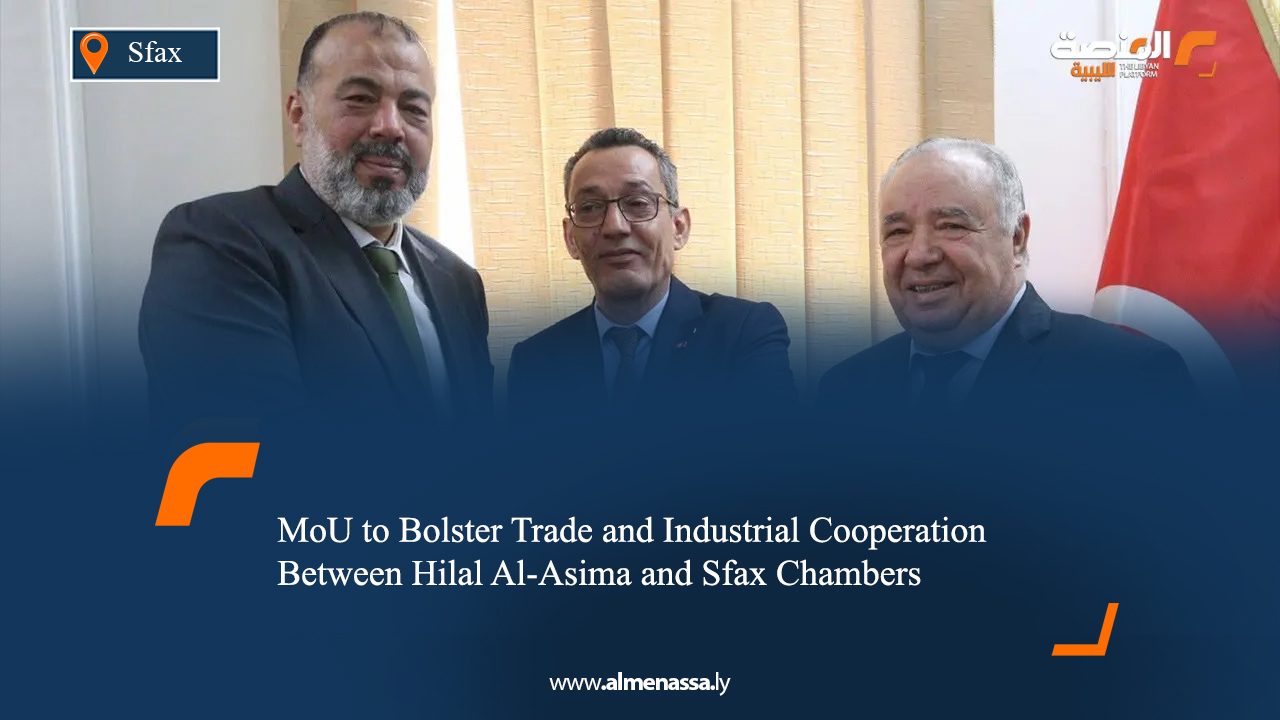
A strategic Memorandum of Understanding (MoU) was signed today in the Libyan capital between the Hilal Al-Asima Chamber of Commerce, Industry, and Agriculture and the Sfax Chamber of Commerce and Industry. This agreement aims to pave new pathways for partnership and mutual investment between the private sectors of both nations. The signing took place in the presence of the Chargé d’Affaires at the Tunisian Embassy in Libya, Mohamed Habib Sassi, alongside economic leaders and officials from the Ministry of Economy and Trade.
Delegation from the Libyan-Chinese Joint Chamber of Commerce visits Benghazi
The memorandum was formally signed by Imad Abu Shala, Chairman of the Hilal Al-Asima Chamber, and Habib Hammami, Chairman of the Sfax Chamber. Key attendees included Abdelmoez Al-Janko, Director General of the Hilal Al-Asima Chamber, Hisham Elloumi, Director General of the Sfax Chamber, Fawzi Wadi, Spokesperson for the Ministry of Economy and Trade, and Hisham Qunaidi, Director of the Foreign Trade Department. The primary objective of the MoU is to facilitate the exchange of technical expertise between business communities and organize joint commercial initiatives that streamline investment flows, with a particular focus on establishing institutional projects that revitalize economic activity across the industrial, trade, and service sectors.
General Authority for Investment Promotion and Turkey’s Bursa Discuss Economic Partnerships
The MoU outlines the organization of bilateral (B2B) meetings between entrepreneurs across various economic fields to explore tangible partnership opportunities and launch joint ventures that increase trade volume. Following the signing ceremony, the Hilal Al-Asima delegation and their counterparts from Sfax conducted a field visit to the “Zat Al-Imad Iron and Steel Company.” During the visit, the delegation reviewed the company’s manufacturing capabilities and discussed potential collaboration in this vital sector to support national industries and create promising investment opportunities.
Participants emphasized that this step serves as a fundamental pillar for building a sustainable business environment and establishing direct communication channels between Libyan and Tunisian economic institutions. It was further agreed to coordinate future reciprocal visits to ensure the practical implementation of the memorandum’s provisions. This ongoing cooperation is expected to enhance product and service quality, bolster competitiveness in regional markets, and ultimately achieve comprehensive economic development that benefits the private sector and generates new employment opportunities in both brotherly nations.