
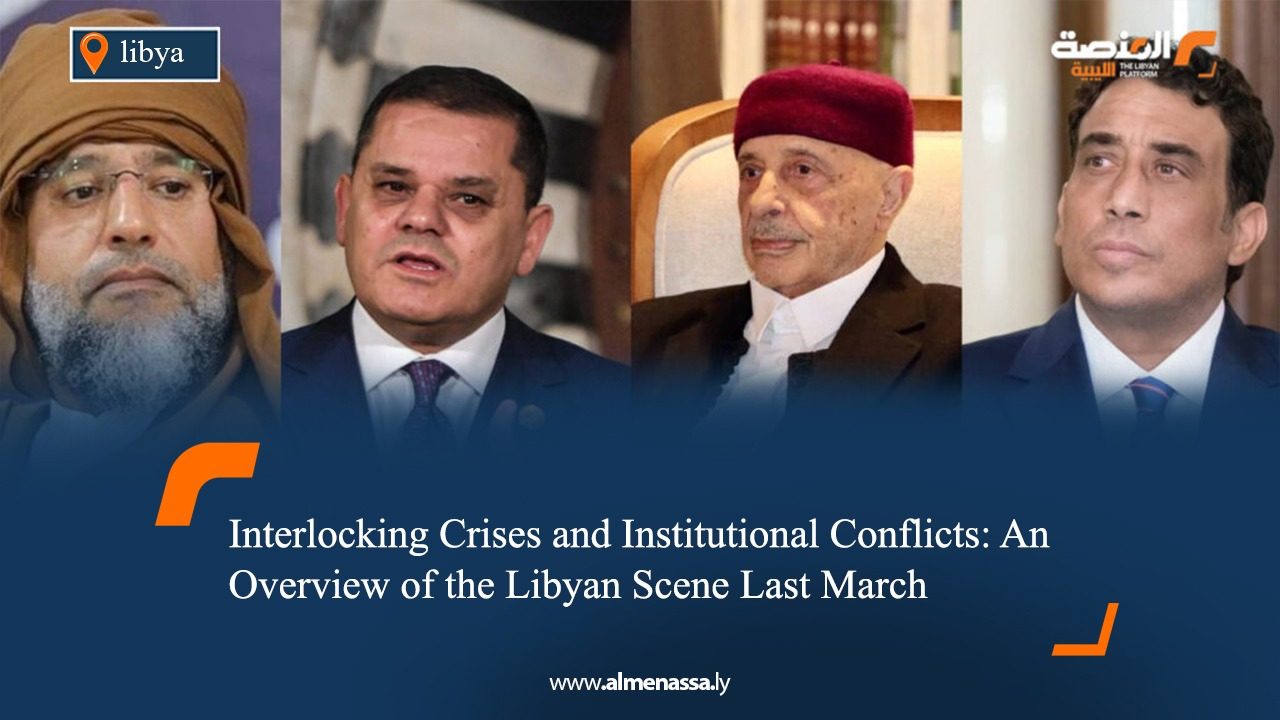
During the month of March, Libya witnessed a sharp escalation in the overlap between political, economic, and judicial files, as controversial decisions deepened institutional divisions. The landscape was dominated by the foreign exchange tax crisis, efforts to reorganize the legislative body, and judicial tensions, alongside an emergency response to environmental and security threats.
The “Currency Tax” Crisis and Parliamentary Leadership Rift
The House of Representatives was shrouded in a state of acute instability following the fallout from the decision to impose a 27% tax on foreign currency exchange. This measure ignited mutual accusations of unilateral decision-making and the overstepping of authorities. The stance of Speaker Aguila Saleh was particularly controversial; he attempted to balance defending the “legal legitimacy” of the procedure—as a technical response to the Central Bank’s proposals—with denying personal responsibility for its approval. Saleh claimed the decision was finalized during an official session in which he was neither present nor presiding, an apparent attempt to distance himself from the resulting political and public backlash.
Conversely, this position deepened the crisis of confidence within the legislative institution, especially after the Deputy Speakers denied knowledge of such a session. Facing mounting pressure and judicial challenges, the Central Bank initiated procedures to abolish the tax. Simultaneously, a parliamentary movement pushed for a reform roadmap to amend internal bylaws and restructure the leadership.
Cabinet Reshuffles and Executive Performance Enhancement
In an effort to modernize administrative operations, the Prime Minister of the Government of National Unity, Abdul Hamid Dbeibah, enacted a cabinet reshuffle covering several portfolios. This move aimed to heighten government efficiency and improve public services by injecting new expertise into executive structures. Despite the stated goals of institutional development, the reshuffle sparked political debate regarding its timing and legitimacy amidst the ongoing institutional rift. This highlighted persistent political friction and its direct impact on the stability of the state’s executive path. The Presidential Council signaled consensus with the government to support these steps and fill ministerial vacancies to ensure operational continuity.
Judicial Division and Challenges to the Rule of Law
On the legal front, the crisis grew more complex with the escalating dispute between the two factions of the Supreme Judicial Council in Tripoli and Benghazi. The two parties exchanged conflicting decisions regarding the transfer and secondment of judges. The Benghazi council rejected transfer orders issued by the council’s leadership in Tripoli, considering them legally void. This conflict has raised serious concerns regarding the independence of the judiciary and the unity of the justice system in the country.
The Commander-in-Chief’s Vision and Comprehensive Evaluation
Amidst these developments, the Commander-in-Chief of the Libyan Arab Armed Forces, Field Marshal Khalifa Haftar, emphasized that maintaining national security and stability is the cornerstone of progress. While receiving delegations of well-wishers for Eid al-Fitr from across Libya, the Field Marshal called for a review of the events the country has witnessed and an evaluation of the current stage to ensure a transition toward a more stable future. He affirmed that the Armed Forces remain in full readiness to defend the nation and protect its resources.
Security Developments and Imminent Environmental Risks
In terms of security, the Public Prosecution in Tripoli made a breakthrough in the assassination case of Saif al-Islam Gaddafi by identifying three suspects and issuing arrest warrants. Environmentally, authorities faced a grave challenge as the Russian gas tanker “Arctic Metagas” drifted toward Libyan shores following an external attack. The National Oil Corporation mobilized efforts with international partners to secure the vessel, which was carrying large quantities of fuel and methane. Moscow’s accusations against Ukrainian entities for the attack added an international dimension to Libya’s interlocking local crises.
Conclusion
The rapid developments in March highlight the increasing complexity of the Libyan landscape, where crises are no longer isolated but impact the stability of all institutions. There is an urgent need to enhance transparency and national consensus to address these overlapping issues. Navigating this period requires a unified approach to safeguard national sovereignty, protect the marine environment, and overcome the political stalemate that threatens the aspirations of the Libyan people for sustainable growth and stability.