
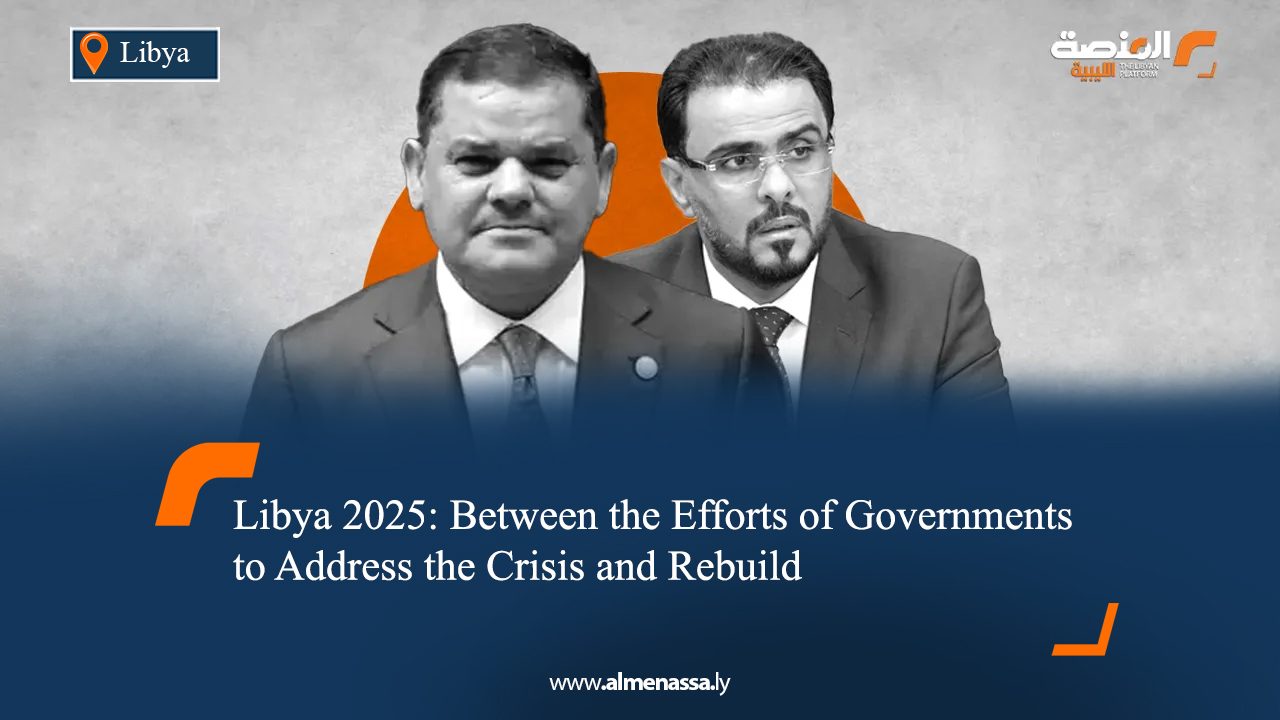
Libya entered 2025 still mired in institutional division, with growing domestic and international pressure to hold elections that could reset the political scene. The year was marked by decisive initiatives and competing strategies, as both Osama Hamad’s eastern‑based government and Abdulhamid Dbeibah’s Government of National Unity (GNU) sought to impose their own vision for managing the transition.
Osama Hamad’s Government: Unified Budget and Sovereignty Agenda
The most prominent step taken by Hamad’s government was the presentation of a unified national budget for 2025, valued at 174.1 billion Libyan dinars, the largest and most comprehensive in years. Covering all sectors, the budget aimed to consolidate financial resources under one framework despite political fragmentation. Hamad emphasized the need to confront “dual spending,” which he described as a major factor weakening the economy. His government also met with the Governor of the Central Bank to discuss financial reform priorities, monetary policy, exchange rates, and funding arrangements, in pursuit of greater economic stability.
Calls for Dialogue and Criticism of the GNU
Hamad called for a “brave and responsible national dialogue” to form a unified government that could lead the country toward presidential and parliamentary elections. At the same time, he sharply criticized Dbeibah’s GNU, accusing it of violating financial laws and engaging in excessive, unplanned spending that failed to improve the lives of citizens. His administration rejected structural changes not approved by the House of Representatives, dismissing the “Supreme Authority of Presidencies” announced by the Presidential Council as unconstitutional, and insisted on protecting sovereign institutions from parallel bodies.
Tensions with UNSMIL and Foreign Actors
Relations with the UN Support Mission in Libya (UNSMIL) deteriorated sharply, culminating in a suspension of cooperation after revelations of a funding arrangement linked to Qatar, which Hamad’s government denounced as a breach of UNSMIL’s mandate and an infringement on Libya’s sovereignty. The government also adopted a confrontational stance toward visiting European officials, ordering some to leave the country upon arrival for failing to respect diplomatic procedures. Hamad went further, warning the Syrian government against transferring fighters to Tripoli, accusing foreign powers of trying to internationalize the Libyan conflict.
Despite internal division, the government maintained an active diplomatic posture, condemning attacks on civilian facilities in Qatar as “cowardly assaults.” Domestically, it strongly supported the “Homeland Movement,” which mobilized across Libya, demanding swift presidential elections and urging the High National Election Commission to prepare accordingly.
Reconstruction and Local Governance Vision
Hamad praised the armed forces for their role in responding to floods and natural disasters, stressing that they remain a cornerstone of state protection during transitional phases and play a central role in emergency infrastructure projects carried out by the Reconstruction Fund. He also advanced a draft law on “local administration and municipalities,” describing it as a transformative step toward decentralization. The law aims to transfer broad powers to municipalities and activate financial and service‑related decentralization, breaking the rigid centralization that had long hindered development.
Abdulhamid Dbeibah’s GNU: Political Initiatives and Rebuilding Projects
Meanwhile, Prime Minister Abdulhamid Dbeibah sought to break political stagnation through new initiatives. In June 2025, he announced a political plan built on three pillars: restructuring the government based on competence, launching a national information platform to reflect public sentiment, and establishing an effective security mechanism to safeguard free and fair elections. The initiative came after months of political tension and public frustration, positioning the GNU as an actor attempting to reset the political process.
Popular Protests and Institutional Criticism
The GNU faced mounting challenges. In May, Tripoli witnessed mass protests dubbed “Friday of Departure,” with demonstrators demanding Dbeibah’s resignation over deteriorating security, poor services, and lack of tangible solutions. The High Council of State added to the pressure, branding his government “illegitimate.” Despite this, the GNU maintained internal cohesion, directing security forces to implement new arrangements aimed at stabilizing the capital.
Cabinet Activity and International Support
Throughout the year, the GNU held intensive cabinet meetings. The first session in April reviewed the Central Bank’s statement and public spending priorities, while a June security meeting assessed the implementation of new security measures in Tripoli. Internationally, the GNU retained full backing from the United Nations and major powers. Domestically, Dbeibah pressed ahead with infrastructure, housing, and road projects under the “Return of Life” initiative launched in January 2025, aiming to rebuild vital facilities and improve services.
The year 2025 marked the coexistence of Libya’s two governments. Hamad’s administration focused on sovereignty, financial unification, and decentralization, while Dbeibah’s GNU sought to break political deadlock through reform initiatives and reconstruction projects. Between popular protests, international pressures, and institutional division, the central question remains: will 2026 bring national elections that finally end the split, or another cycle of confrontation and political polarization?