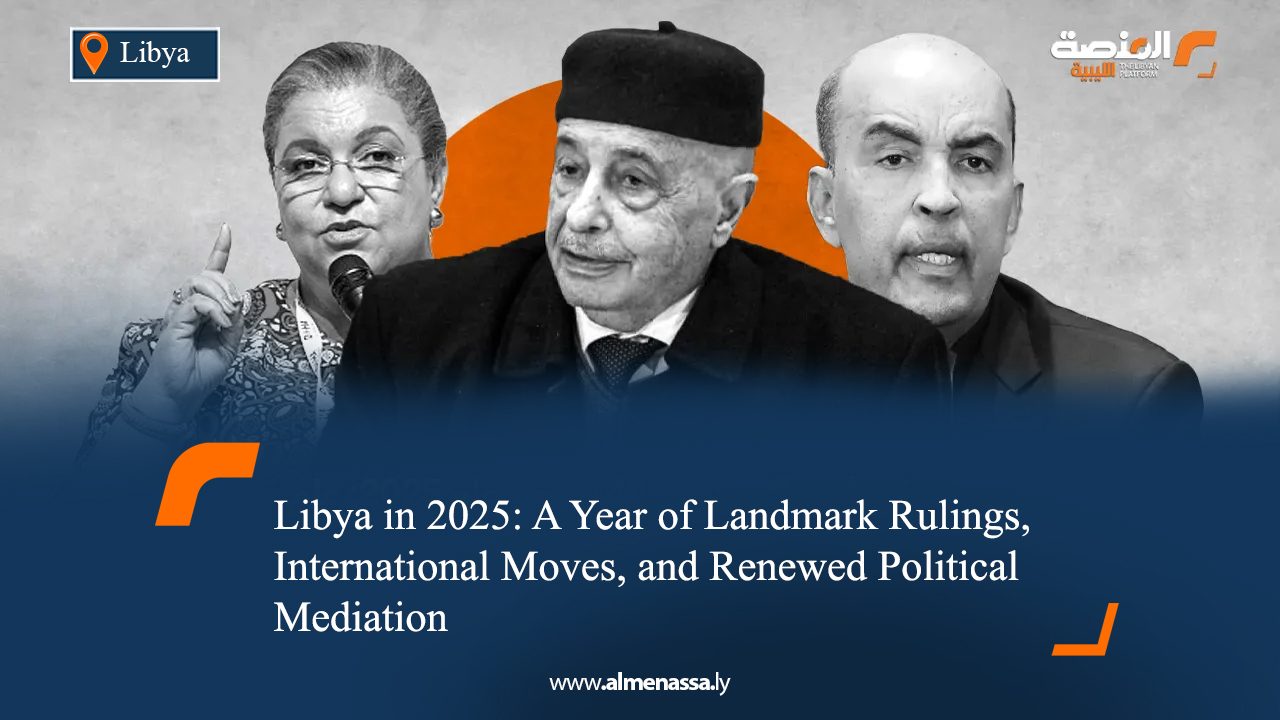
Libya entered 2025 still mired in political and military division, with the electoral process stalled. Yet the year unfolded with decisive judicial rulings, international initiatives, and renewed diplomatic engagement that brought questions of legitimacy and accountability back to the forefront, marking 2025 as a pivotal chapter in the country’s protracted transition.
Judicial Milestones and International Accountability
The Constitutional Chamber of the Supreme Court issued a landmark ruling affirming the constitutionality of the 2015 Libyan Political Agreement signed in Skhirat. Members of the Presidential Council, Musa al‑Koni and Abdullah al‑Lafi, welcomed the decision as a reaffirmation of the rule of law and a restoration of the legal and political framework guiding Libya’s transition. In parallel, Libya formally accepted the jurisdiction of the International Criminal Court (ICC) over crimes committed from 2011 through the end of 2027, a move seen as strengthening mechanisms of investigation and accountability for grave violations during years of conflict.
Sovereignty Disputes and Maritime Boundaries
The maritime memorandum of understanding signed with Turkey in 2019 resurfaced as a contentious issue. Greece reiterated its rejection of the agreement, labeling it “illegal,” while the Government of National Unity defended its validity as part of safeguarding Libya’s sovereign rights. In December 2025, Speaker of the House of Representatives Aguila Saleh traveled to Athens to discuss developments surrounding the maritime file, underscoring the enduring regional disputes over Mediterranean boundaries.
UN Efforts to Revive the Political Track
The United Nations Support Mission in Libya (UNSMIL), under the leadership of Special Representative of the Secretary‑General Hanna Tetteh, intensified efforts to restart the political process. The mission launched a structured dialogue aimed at agreeing on unified electoral laws and forming a single transitional government to lead Libya toward long‑delayed elections. In February 2025, UNSMIL established an advisory committee of twenty Libyan figures tasked with drafting proposals for electoral legislation. Later, on 20 June, the International Follow‑Up Committee convened in Berlin under joint chairmanship of Tetteh and Germany, reaffirming support for a Libyan‑led process.
The mission also secured Qatari backing for the structured dialogue and civic participation, though the initiative faced strong domestic opposition as an infringement on sovereignty. UNSMIL repeatedly warned that prolonged delays and entrenched division jeopardize prospects for stability and risk derailing the transition altogether.
Security Council Decisions and International Support
The UN Security Council adopted Resolution 2796 on 31 October 2025, extending UNSMIL’s mandate until October 2026 and renewing international support for Tetteh’s leadership. Following clashes in Tripoli in May, the Council expressed deep concern over escalating violence, called for accountability for attacks against civilians, and stressed adherence to the 2020 ceasefire agreement.
In January 2025, the Council amended the sanctions regime to allow training and technical assistance for Libya’s unified security forces, while maintaining the arms embargo to prevent weapons from reaching unauthorized actors. It reiterated demands for the immediate withdrawal of all foreign forces, fighters, and mercenaries, in line with the work of the Joint Military Commission (5+5). The Council also welcomed municipal elections held during the year and emphasized that unifying sovereign institutions, particularly the Central Bank and the military and security sectors, remains essential for financial and political stability.
European Engagement and Development Programs
Complementing UN efforts, the European Union launched a new cooperation program for 2025–2027. The initiative focuses on supporting stability and development, strengthening security, addressing migration challenges, and advancing governance and economic reform. The program reflects Europe’s intent to link Libya’s political track with broader developmental and security frameworks, aiming to stabilize the country while mitigating regional spillovers.
Taken together, the judicial rulings, international decisions, and UN‑led mediation defined 2025 as a year of serious attempts to place Libya back on a unified political path. Despite persistent challenges and divisions, these developments reinforced the principle of accountability, restored a legal foundation for the transition, and renewed international backing. Whether these efforts culminate in comprehensive elections that finally close Libya’s long transitional chapter remains the decisive question for the years ahead.