
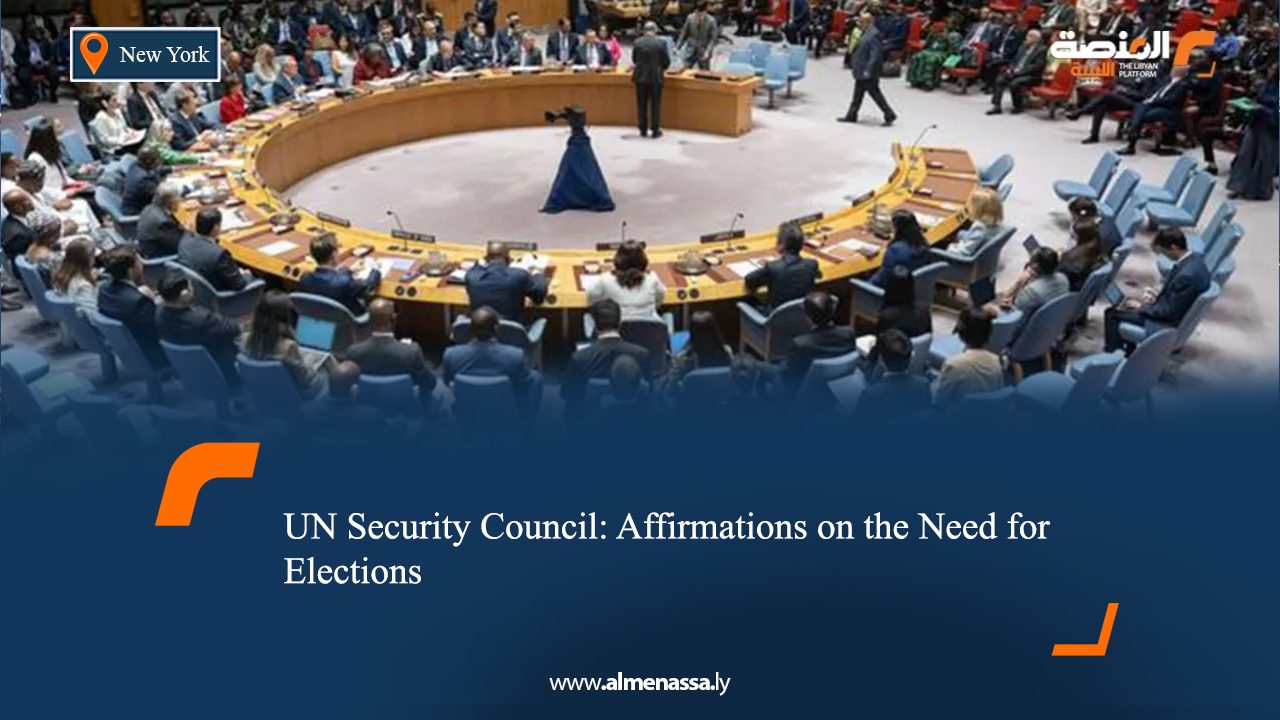
The UN Security Council held an intensive and prolonged session to discuss the alarming, accelerating, and dangerous developments in Libya, where a state of deep international concern dominated the interventions of member states’ representatives and UN mission officials, who expressed fears regarding the continued political deadlock and its catastrophic impact on the country. The discussions reached a consensus that the current political stalemate, institutional division, and the deterioration in economic and security conditions can no longer tolerate further delay or unilateral actions. Calls varied between emphasizing the rapid implementation of the UN roadmap and urging urgent measures to hold decisive presidential and parliamentary elections to end all transitional phases. Many speakers warned that time is running out and that the continuation of the current situation threatens a collapse of the Libyan state.
UN Mission’s Vision: Complexities of the Political Path and Judicial Risks
Hanna Tetteh, the UN Envoy to Libya, explained in her detailed briefing to the Council that the mission’s intensive efforts to activate structured dialogue in Tripoli have shown an urgent need to end the economic deadlock and unify governance. Tetteh indicated that the reconciliation and human rights path focuses fundamentally on protecting the judiciary from political interference to ensure its independence and unity, warning that unilateral actions by Libyan parties threaten the unity of the High National Elections Commission. Tetteh added that the continued judicial division will lead to the creation of a paralyzed and torn legal environment, making any future electoral process void and unrecognized internationally or locally.
Divided Perspectives: House of Representatives and High Council of State Members on the UN Security Council’s Role in Libya
The mission also urged the House of Representatives and the High Council of State to reach an immediate consensus and overcome their differences to amend the electoral framework, noting that individual actions undermine credibility and increase citizens’ conviction regarding the lack of seriousness of the two institutions in completing the electoral process. Tetteh announced the mission’s intention to form a small group to break the deadlock, considering that the opportunity still exists to implement existing Libyan tools if political will is available, even though current realities do not allow for waiting indefinitely. She also confirmed that the mission is working to provide the necessary technical and logistical support to ensure the integrity of the electoral process if a specific date is agreed upon, emphasizing that the United Nations will not support any path leading to further division.
On the human rights front, Tetteh demanded that Libyan authorities conduct a transparent investigation into the circumstances of Saif al-Islam Gaddafi’s assassination and ensure the accountability of those responsible. She also offered her condolences for the victims of the tragic plane crash, praising the role of Mohamed al-Haddad in supporting the unification of the military institution. She also warned that the exchange of judicial rulings between Tripoli and Benghazi threatens the unity of the judicial system, and confirmed that Libya has become a hub for drug smuggling and human trafficking, which exacerbates corruption and drains state resources in the absence of a unified budget. Tetteh emphasized the necessity for everyone to stop taking escalatory measures that deepen division, weaken state institutions, and harm citizens.
Civil Society Perspective: Fair Elections are the Only Solution
Ahmed Al-Bibas, head of “Mumkin” organization, confirmed that the Libyan people have been stuck since 2011 in a vicious cycle of disappointing hopes and false promises, emphasizing the need for a state of law and a unified army instead of armed groups. Al-Bibas explained that the three main challenges are the mirage of electoral promises, the fragility of the security situation due to the proliferation of weapons, and the war economy that feeds on the political vacuum. He noted that the Libyan citizen has lost confidence in the current political elite, which seeks to maintain its positions rather than serve the nation and achieve its aspirations.
He stressed that the Libyan citizen suffers from deteriorating services and a high cost of living despite the country’s wealth, noting that the devaluation of the dinar drives toward organized crime. Al-Bibas called for supporting a binding electoral path led by the United Nations, seriously activating international sanctions against those obstructing elections and oil smugglers, and the need to unify the military institution and protect civil society organizations. Al-Bibas noted that the Derna disaster clearly revealed the fragility of the state and the danger of corruption that can kill more than weapons do in conflict. He also called on the international community to support the role of civil society in monitoring the electoral process and ensuring its transparency.
International Positions: American, Russian, and French Measures to Unify the Country
The representative of the United States, Massad Boulos, confirmed that his country is working to bring officials from the East and West together to integrate military and economic institutions, announcing joint training for Libyan forces from both sides in Sirte under the supervision of “AFRICOM.” He emphasized that the United States will not tolerate any party seeking to obstruct the democratic path in Libya, noting the possibility of imposing new sanctions.
For his part, the Russian representative condemned the assassination of Saif al-Islam Gaddafi, describing it as brutal, and demanded a fair investigation. He expressed concern over the deterioration of security conditions in Tripoli and the south, confirming his country’s support for the gradual political process that includes everyone, and welcoming the efforts of the African Union in the reconciliation file. Russia emphasized that the political solution must be achieved through a purely Libyan-Libyan dialogue without external intervention.
In the same context, the French representative stated that the Libyan crisis has lasted too long, calling for support for the UN roadmap to unify institutions. He emphasized that unifying security forces and the withdrawal of foreign forces are the top priority for the Security Council, stressing the need to strengthen economic transparency and fight corruption.
The United Kingdom, China, the European Union, and Their Positions
The representative of the United Kingdom stressed that political violence has no place in Libya’s future, considering that the killing of Saif al-Islam Gaddafi doubles existing challenges. He noted that the current situation is unsustainable and that the people are waiting for unified governance that brings peace and prosperity, calling for the participation of all parties in the political process.
The Chinese representative expressed grave concern over the deterioration of the security situation and the lack of trust between Libyan parties, especially regarding electoral laws and the elections commission. He called for addressing the root causes of militia proliferation, adopting a unified national budget, and protecting Libyan assets abroad.
Libyan Vision: Ending Transitional Phases and Unifying Legitimacy
Libya’s representative, Taher al-Sunni, condemned the assassination of Saif al-Islam, noting that the Attorney General’s office is conducting investigations to ensure the rule of law. Al-Sunni called on the Security Council to support the will of the Libyan people in determining their destiny, and to move from the consultation stage to binding results. He confirmed that the Libyan government is committed to providing a safe environment for holding elections across the country.
Al-Sunni stressed that any political path must aim to end the transitional phases, not reproduce them, through elections based on implementable laws. He warned of the dangers of parallel spending, which disrupts monetary policy and threatens the economy, confirming that the future of the relationship with international partners must be built on respect for national sovereignty.
Taher El-Sonni and Hanna Tetteh Discuss Political Developments Ahead of Security Council Briefing
Economic and Security Developments: Smuggling of Resources and Currency
The UN Envoy indicated in her report that Libya has become a hub for drug smuggling and that Libyans are suffering economically due to currency depreciation and growing public discontent. She explained that the lack of a unified national budget, uncoordinated public spending, and declining oil revenues lead to imbalances in foreign currencies and pressure on reserves.
Improving Conditions and the Need for National Reconciliation
The mission emphasized the need to hold accountable those who take measures aimed at dividing the judiciary and weakening justice. It noted the importance of the women’s group in structured dialogue to enhance women’s participation. It demanded the necessity of protecting civil society organizations, condemning threats against them, and stopping arbitrary measures taken against them by the Central Bank. It emphasized that national reconciliation must be based on the principles of transitional justice and human rights.
Implications of the Situation on Neighbors and Regional Stability
Other interventions indicated that continued chaos in Libya threatens stability in the Sahel and Sahara region, necessitating greater security coordination between neighboring countries to combat terrorism and organized crime. Some countries emphasized the need to support reconciliation efforts led by Libyans themselves to ensure a lasting and comprehensive solution to the conflict.
Legal and Ethical Responsibility of the International Community
Member states called for the international community to shoulder its responsibility in supporting Libya to restore its sovereignty and the independence of its national decision-making. It was emphasized that lifting sanctions on frozen Libyan assets must be conditioned on the existence of transparent mechanisms to ensure their use in development and reconstruction, not in financing conflicts or corruption.
Future of Libyan Institutions
The speeches reached a consensus that unifying the Central Bank of Libya and the National Oil Corporation are cornerstones in building trust and paving the way for economic and political stability. Countries demanded the necessity of stopping all forms of external interference in Libyan affairs and adhering to relevant Security Council resolutions.