
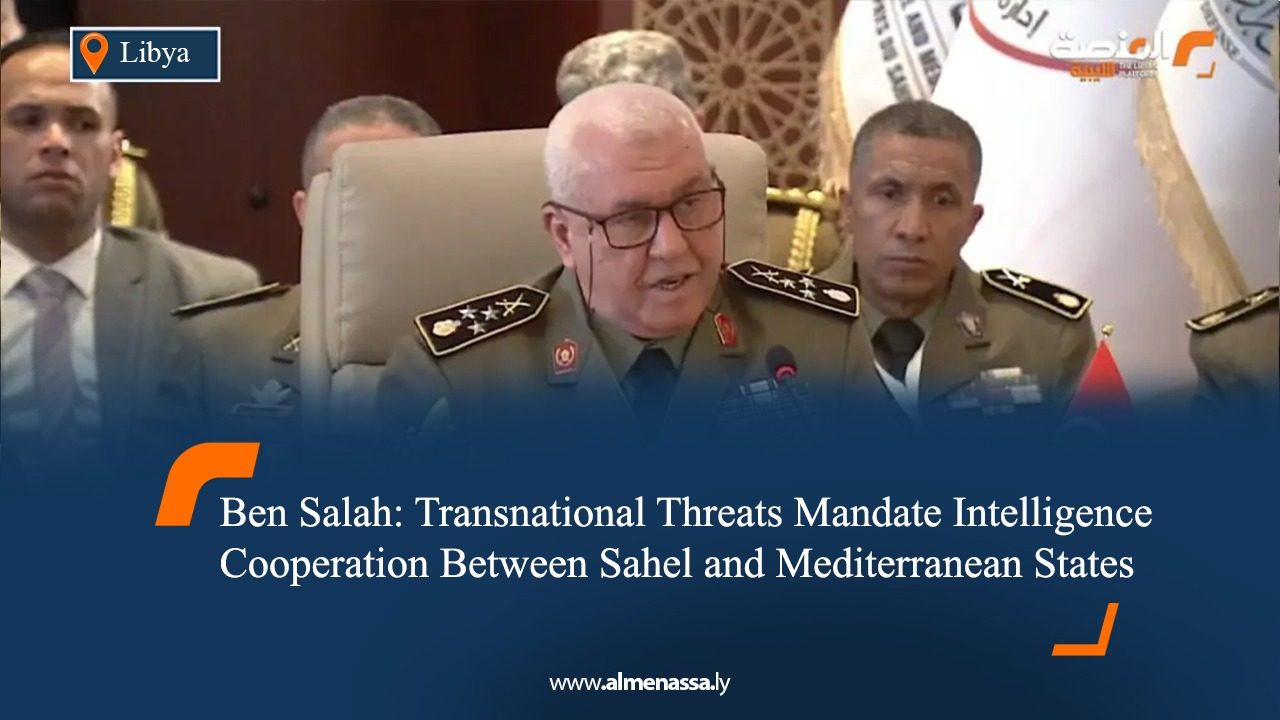
Tripoli hosted The second edition of the Military Intelligence Chiefs’ Conference of Sahel and Mediterranean Countries. The event brought together heads and representatives of military intelligence agencies from allied and friendly nations, aiming to enhance security partnerships and exchange expertise in response to the rapidly evolving challenges facing the region.
In a speech delivered by General Habib Ben Salah, Director of Intelligence for the Republic of Tunisia, he emphasized that the convening of this second session reflects a growing recognition of the important role played by military intelligence in addressing complex security threats. Ben Salah noted that these challenges are no longer confined within national borders but have become transnational, encompassing international terrorism, organized crime, and cyber threats, alongside issues of illegal migration and human trafficking.
Artificial Intelligence as a Tool for Criminal Networks
The Tunisian official explained that technological advancements, particularly in the field of artificial intelligence, represent a new frontier of challenges. Criminal networks and terrorist organizations are increasingly exploiting these tools to execute sophisticated cyberattacks, disseminate misinformation, and launch complex fraudulent operations targeting both individuals and institutions. This reality necessitates heightened security readiness and collective coordination among nations.
Ben Salah highlighted that since 2016, Tunisia has adopted a national strategy to combat terrorism and violent extremism, based on a multi-dimensional approach involving various state institutions. He confirmed that this strategy has significantly contributed to reducing terrorist threats by dismantling sleeper cells and neutralizing numerous extremist elements, thanks to proactive intelligence work and cooperation with neighboring countries, particularly Libya and Algeria.
Three Pillars to Face Shared Threats
He stressed that qualified human personnel represent the fundamental pillar for successful intelligence operations, calling for more cooperation in education and training between countries through the exchange of expertise and joint visits. Such efforts contribute to developing curricula and unifying security concepts.
Furthermore, he advocated for the establishment of effective and secure mechanisms for the immediate exchange of information between intelligence agencies. He also proposed holding regular expert meetings to assess risks and update cooperation strategies, thereby fostering mutual trust and ensuring a more effective response to common challenges.
Ben Salah emphasized that international intelligence cooperation has become an absolute necessity in light of increasing global interconnectedness, noting that the success of such collaboration depends primarily on building mutual trust and respecting national sovereignty. The Tunisian official concluded by reaffirming his country’s commitment to ongoing joint action with sisterly and friendly nations to develop security cooperation mechanisms, expressing hope that the conference’s deliberations would yield practical results that enhance regional security and stability.