
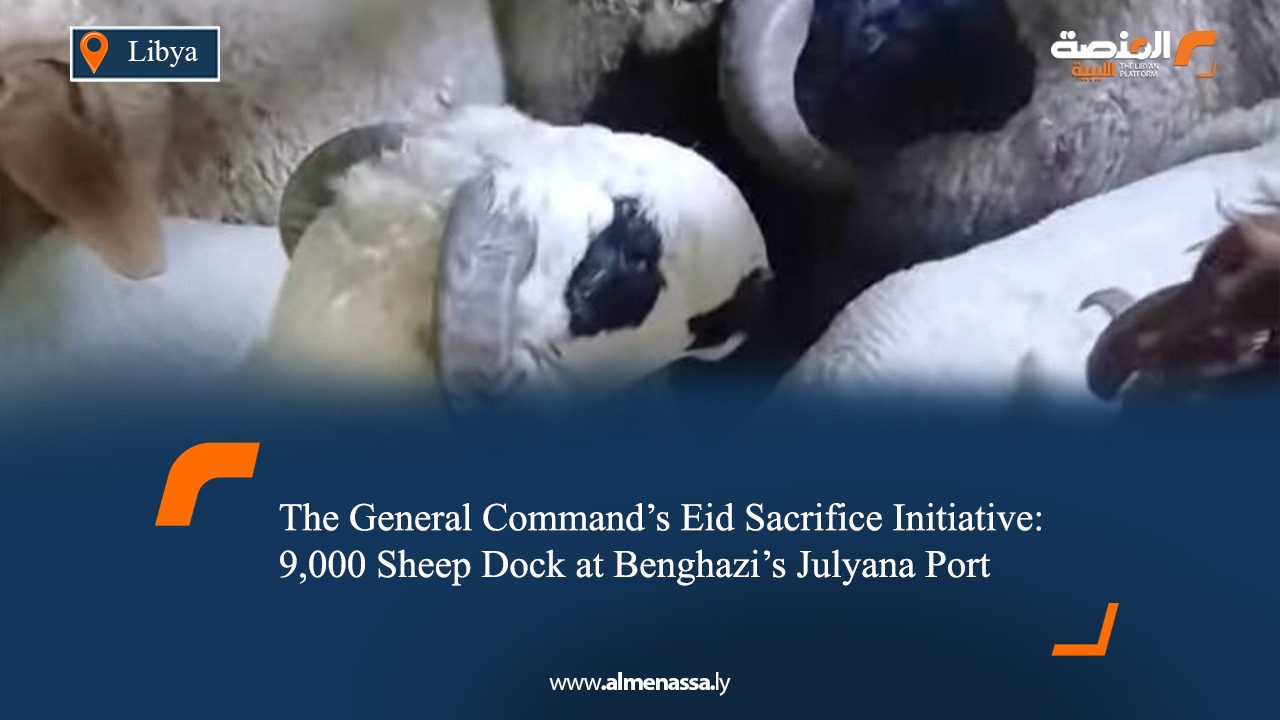
The commercial vessel Helana has successfully docked at the berths of the Julyana Free Zone port in Benghazi, executing the delivery of the second major consignment of subsidized livestock sponsored directly by the General Command of the Armed Forces. Transported from the Syrian port of Tartus, this latest maritime shipment carries approximately 9,000 head of live sheep. The operation represents a humanitarian and economic intervention to supply sacrificial animals at subsidized and affordable prices, countering the financial pressures facing Libyan families as Eid al-Adha approaches.
This initiative is part of a continuous, well-coordinated effort to augment the domestic livestock supply, correct market distortions, and curb the unprecedented price spikes that have plagued livestock markets during previous holiday seasons. By infusing the market with high-quality alternatives, the initiative directly aims to dismantle monopolistic practices, lower the cost of living for middle- and low-income households, and ensure that families across the region can fulfill their religious observances without enduring severe financial strain or excessive commercial exploitation.
Bobaker Towfeek, Executive Director of Al-Mawsem Company for Agricultural and Livestock Investment, clarified that this shipment is the second phase of an interconnected supply chain scheduled to arrive progressively over the coming weeks. He noted that the cumulative target of the initiative is positioned at 50,000 head of sheep, a figure that remains flexible and subject to upward adjustments based on continuous market assessments and consumer demand. Towfeek emphasized that the imported livestock consists of the renowned Syrian “Awassi” breed, alternatively known as “Nuaimi,” which is highly regarded for its premium meat quality and ideal average weight of around 60 kilograms per head. This specific breed shares nearly identical physical and culinary traits with the native Libyan “Barqawi” sheep, rendering it exceptionally popular among local consumers while fully satisfying all statutory veterinary regulations and Islamic jurisprudential requirements for sacrificial animals.
In terms of public health safeguarding and safety compliance, medical and administrative teams at Julyana Port confirmed that the entire cargo was subjected to rigorous, multi-tiered veterinary inspection protocols immediately upon the vessel’s arrival. Quarantine officers conducted clinical evaluations, random biological sampling, and thorough audits of the accompanying international health certificates to guarantee that the animals were completely free of any infectious or zoonotic diseases before clearing the cargo for offloading. Following the successful completion of these statutory health and customs clearances, the port’s cargo handling and storage department, in close coordination with the Livestock Transport Association, initiated highly organized offloading operations. Streamlined logistical arrangements were deployed to facilitate the swift, safe transit of the livestock to designated state-backed distribution centers and retail hubs, avoiding animal fatigue and ensuring a constant, reliable supply as anticipation builds for consecutive shipments destined for Libyan ports in the near future.