
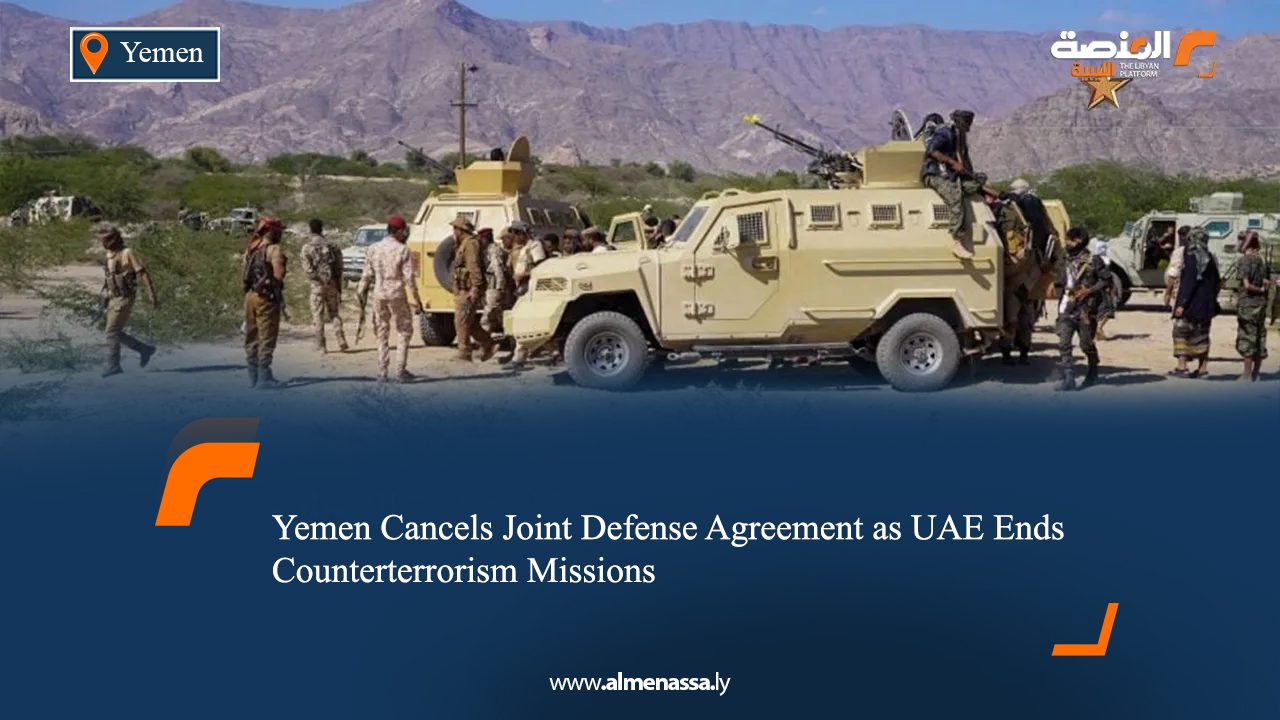
On Tuesday, Presidential Leadership Council Chairman Rashad al-Alimi announced the cancellation of the joint defense agreement with the United Arab Emirates, requiring all Emirati forces to leave Yemen within 24 hours. He also declared a 90‑day state of emergency, renewable, to confront what he described as attempts to divide the republic. Al‑Alimi stressed that these measures aim to safeguard Yemen’s unity against separatist calls by the Southern Transitional Council.
UAE’s Position
The UAE Ministry of Defense stated that it had ended its counterterrorism missions in Yemen “of its own will,” in coordination with international partners. The ministry noted that the UAE had joined the Arab Coalition in 2015 to support legitimacy against the Houthis, and that Emirati forces had made “great sacrifices” to achieve Yemen’s security and stability. It added that the UAE military presence formally ended in 2019 after completing agreed tasks, with only specialized counterterrorism teams remaining. The ministry explained that recent developments and their impact on the safety and effectiveness of operations prompted the UAE to withdraw these teams, stressing that the decision aligns with the country’s commitments to regional security and stability.
Saudi Arabia’s Position
Saudi Arabia declared that its national security is a “red line” and vowed to take all necessary measures to counter threats, particularly along its southern borders. Riyadh emphasized that dialogue is the only way to address the southern issue. It accused the UAE of pushing the Southern Transitional Council’s forces to carry out military operations along its southern frontier in Hadramawt and al‑Mahra provinces. The UAE Foreign Ministry rejected these accusations, describing them as “claims,” and reaffirmed its commitment to Saudi security.
Arab Coalition’s Position
The Saudi‑led Arab Coalition announced that it had carried out airstrikes targeting weapons and combat vehicles that had arrived from the UAE’s Fujairah port aboard two ships to Mukalla port, which is under the control of the Southern Transitional Council. The coalition stressed that its operations aim to prevent any threats to Yemen and the wider region.
Since early December, Southern Transitional Council forces have controlled Hadramawt and al‑Mahra, which together make up nearly half of Yemen’s territory (around 555,000 square kilometers), and have resisted local, regional, and international calls to withdraw. The council faces broad rejection of its push for southern secession, yet its Vice President Ahmed Saeed bin Buraik declared that “the announcement of the State of South Arabia is closer than ever.” The council argues that successive governments have politically and economically marginalized southern regions and demands separation, while Yemeni authorities insist on preserving national unity. It is worth noting that on May 22, 1990, the Yemen Arab Republic (North) and the People’s Democratic Republic of Yemen (South) united to form the Republic of Yemen.