
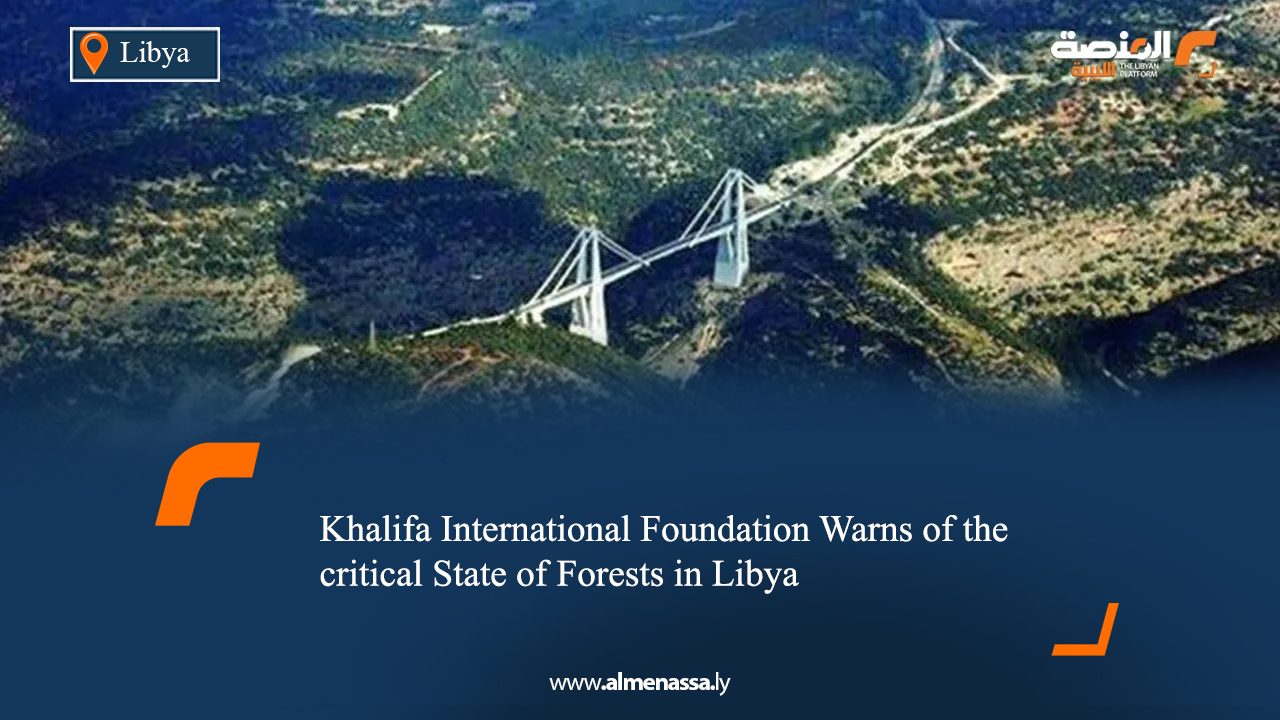
In an era where the global community is grappling with unprecedented climate challenges, the degradation of forests in Libya has emerged as one of the most pressing environmental issues facing the nation. The Khalifa International Foundation for Humanitarian Works recently published a detailed report that reflects profound concern regarding the current state of green spaces across the country. The report states that the vegetation cover is struggling for survival under the combined weight of systematic human encroachment and extreme climatic shifts. This crisis is exacerbated by a near-total absence of deterrent policies and effective technical mechanisms to safeguard what is considered a vital strategic resource. This report does not merely highlight statistics; it raises questions about the resilience of local ecosystems in the face of resource depletion that threatens the nation’s environmental security.
The Role of Vegetation in Combating Accelerated Desertification
Although Libya’s geographical characteristics naturally categorize it as a forest-poor nation—with forest areas not exceeding 1% of the total landmass—this small percentage serves as the primary line of defense against the relentless encroachment of the Sahara Desert. These green belts act as the only lung ensuring environmental equilibrium in a region defined by severe aridity. The Foundation’s report clarifies that Libyan forests are no longer facing incidental or seasonal threats; instead, they have become victims of a recurring pattern of wildfires and over-extraction that has reduced tree cover by 5% since the turn of the millennium. This decline is more than just a statistical figure; it is a critical indicator of the gradual loss of biodiversity and the soil’s decreasing ability to retain moisture and resist the increasingly frequent sandstorms that strike Libyan urban centers.
International media reports, most notably from France 24, have identified security chaos and the absence of clear environmental policies since 2011 as the primary catalysts for forest destruction. France 24 noted that the collapse of state authority created an environment that “legitimatized” encroaching upon forests under flimsy pretexts. Ancient trees are often cleared under the guise of “removing damaged vegetation,” only to be followed by large-scale bulldozing to convert these areas into private residential plots. This “destructive investment” is a major driver behind the alarming figures reported by the Khalifa Foundation and other bodies, where forests are viewed as obstacles to real estate expansion rather than national assets.
Data: Statistics on Loss and Carbon Emissions
According to data tracked by the Foundation, supported by Global Forest Watch and municipal field assessments, Libya has lost at least 341 hectares of vegetation cover over the past two decades. In 2023 alone, the country suffered the loss of approximately 192 hectares of its natural forest lands. The impact of this loss is multifaceted: it disfigures the natural landscape and destroys wildlife habitats, while simultaneously resulting in the emission of roughly 49.6 kilotons of carbon dioxide. These emissions contribute directly to the intensification of local global warming effects, creating a micro-climate of increased heat and reduced humidity, which further weakens the environment’s capacity for natural regeneration and fosters a vicious cycle of drought and increased fire susceptibility
In a deep dive into the field conditions in the eastern part of the country, the report focuses heavily on Al-Jebel Akhdar (Green Mountain) region, particularly Al-Qubba area. A specialized scientific study discussed at Omar Al-Mukhtar University in October 2024 revealed a “frightening” loss of 45% of the forest vegetation in this region between 1987 and 2020. Environmental experts, including Professor Salem Al-Shatshat of Benghazi University, link this rapid degradation to the security and administrative vacuum the country has experienced since 2011. The absence of effective legal authority and monitoring has essentially turned forests into “open targets.” Consequently, unregulated urban expansion surged by a staggering 516% in some areas at the expense of perennial trees such as Juniper and Arbutus, driven by intense population pressure and internal displacement without structured urban planning to divert growth away from these sensitive green lungs.
Charcoal Production and Weak Legal Deterrence
The causes of degradation are not confined solely to urban sprawl. They extend to include highly destructive and illegal economic activities, most notably the charcoal production industry, which has seen increased demand due to recurring energy and heating crises. Dr. Abdulmonem Al-Barani emphasizes that the rising demand for heating and grilling fuel provides a powerful financial incentive for the indiscriminate logging of ancient trees. This is a destructive practice for which responsibility lies not only with the loggers and traders but also with the consumers who sustain this illegal black market. This crisis is further compounded by a weak legislative and judicial framework; environmental activists point out that fines for illegal logging range between only 50 and 100 Libyan Dinars—an amount that offers no real economic deterrence and is viewed by violators as a negligible fee for destroying an irreplaceable national treasure.
On the ground, the tragedy of the forests is captured in the testimonies of citizens and volunteers attempting to fill the void left by state institutions. Volunteers like Abu Bakr Shhayma, who works to protect forests east of Tripoli, describe how green spaces adjacent to residential areas have become daily targets for cutting, either for construction or charcoal production. He notes that perpetrators exploit periods of weak security oversight to clear large tracts of trees under the guise of “cleaning the land” or “removing damaged trees,” while the underlying goal is to change the land’s classification from forest to residential to skyrocket its market value. These assaults have led to the fragmentation of forest areas, making them significantly more vulnerable to wildfires and less capable of hosting the unique plant and animal biodiversity that has characterized Libya for decades.
Vision for Restoration and Environmental Sustainability
The report outlines a clear vision of the requirements necessary to salvage what remains, warning that a “reactive” approach to environmental disasters will not stop the ongoing bleeding of resources. Khalifa International Foundation calls for a transition toward an “early monitoring” and proactive warning strategy using remote sensing technologies and satellite data to detect any change in vegetation cover or the start of a fire in its infancy. Furthermore, the Foundation stresses that forests must be viewed as “strategic assets” capable of supporting the local economy through sustainable eco-tourism and natural products, rather than being treated as vacant, neglected lots awaiting cement expansion. The current lack of accurate, updated data is a major hurdle for researchers and executive bodies, necessitating the creation of a national database for Libya’s vegetation cover.
Libyan forests currently stand at a crossroads. One path involves continuing the policy of neglect and silence regarding logging, quarrying, and random construction, which will inevitably lead to the total desertification of the country and the disappearance of the last bastions of biodiversity within a few decades. The alternative path is the immediate implementation of a “National Green Rescue Project” that includes the reforestation of damaged areas, the imposition of truly deterrent legal penalties commensurate with the environmental crime, and the real activation of the “Agricultural Police” and forest guards. The Khalifa International Foundation concludes its report by asserting that sincere political will and close community cooperation are the only keys to saving this natural heritage. The cost of protecting and restoring forests today remains remarkably low compared to the staggering cost future generations will pay for the loss of environmental balance and the unchecked spread of desertification, making environmental protection an inseparable part of the struggle for national survival and prosperity in Libya.