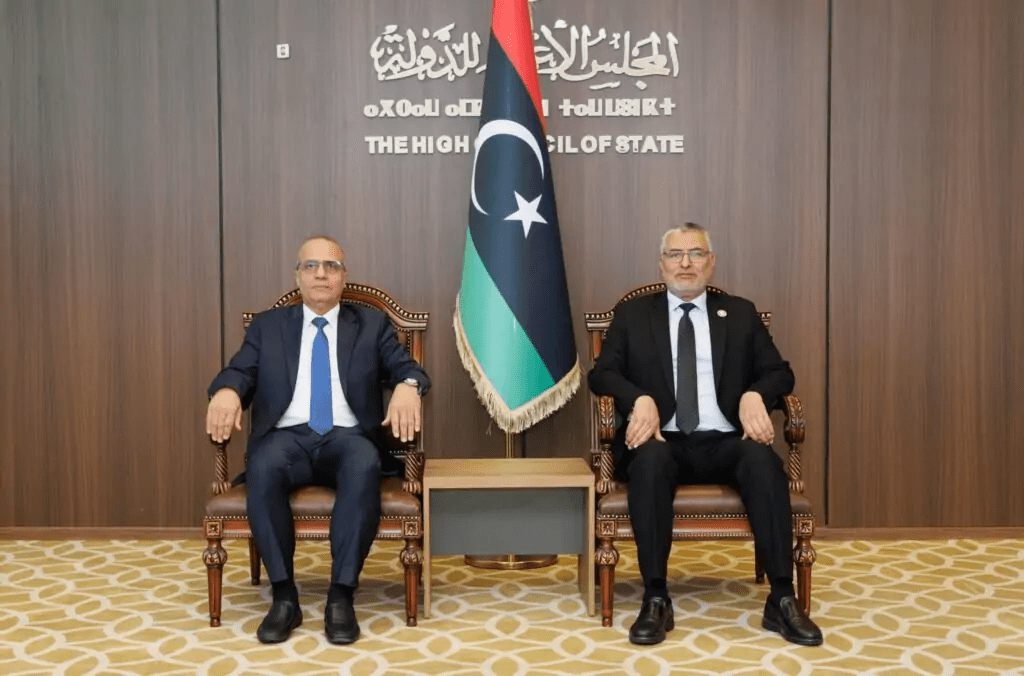
The President of the High Council of State, Dr. Mohamed Takala, and the Deputy of the Presidential Council, Abdullah al-Lafi, engaged in extensive discussions aimed at navigating Libya out of its current political stalemate. The dialogue centered on the strategic necessity of unifying various political initiatives into a single, cohesive framework. Both leaders underscored that the current proliferation of fragmented proposals without central coordination only serves to prolong the crisis and deepen institutional divisions. They emphasized that building a robust, consensual foundation is the only viable path toward holding the long-awaited national elections. This process, they noted, must strictly adhere to the Libyan Political Agreement, which remains the definitive legal reference for governing the relationships between sovereign institutions and safeguarding their unity against further fragmentation.
During an assessment of the political landscape, Takala and al-Lafi scrutinized the structural challenges hindering a settlement. They agreed that the current stage demands a pragmatic reading of the situation—one that moves beyond rhetoric to identify core points of contention and work systematically to narrow them. The meeting issued a stern warning against drifting toward “parallel political tracks” or unilateral decisions, which risk complicating the crisis and undermining the stability of national institutions. Instead, they advocated for sustained institutional dialogue as the most effective mechanism for navigating Libya’s complex realities. Any future solutions, they argued, must be built on a shared platform that ensures inclusivity and practical implementability, ultimately fulfilling the Libyan people’s aspirations for a transition into a permanent and stable political era.
The electoral file remained at the heart of the deliberations, identified as the ultimate strategic objective for concluding the country’s successive transitional phases. The two officials discussed the essential prerequisites for a successful electoral process, including the drafting of a clear constitutional basis and the unification of relevant executive bodies. They also highlighted the importance of securing a stable political and security environment to facilitate the vote. A central theme of the discussion was that the success of any election depends not only on technical readiness but also on a broad national consensus to ensure that the results are accepted and legally insulated from subsequent challenges. The meeting concluded with a call for political institutions to exercise their historical responsibility by bridging gaps and presenting realistic initiatives that prioritize the national interest, viewing this coordination as a vital step toward restoring trust and paving the way for a definitive end to institutional division.
Al-Menfi and Dabaiba meets to discuss political developments in Libya
Dabaiba and Menfi fear the international community’s support of a binding plan to form new authorities