
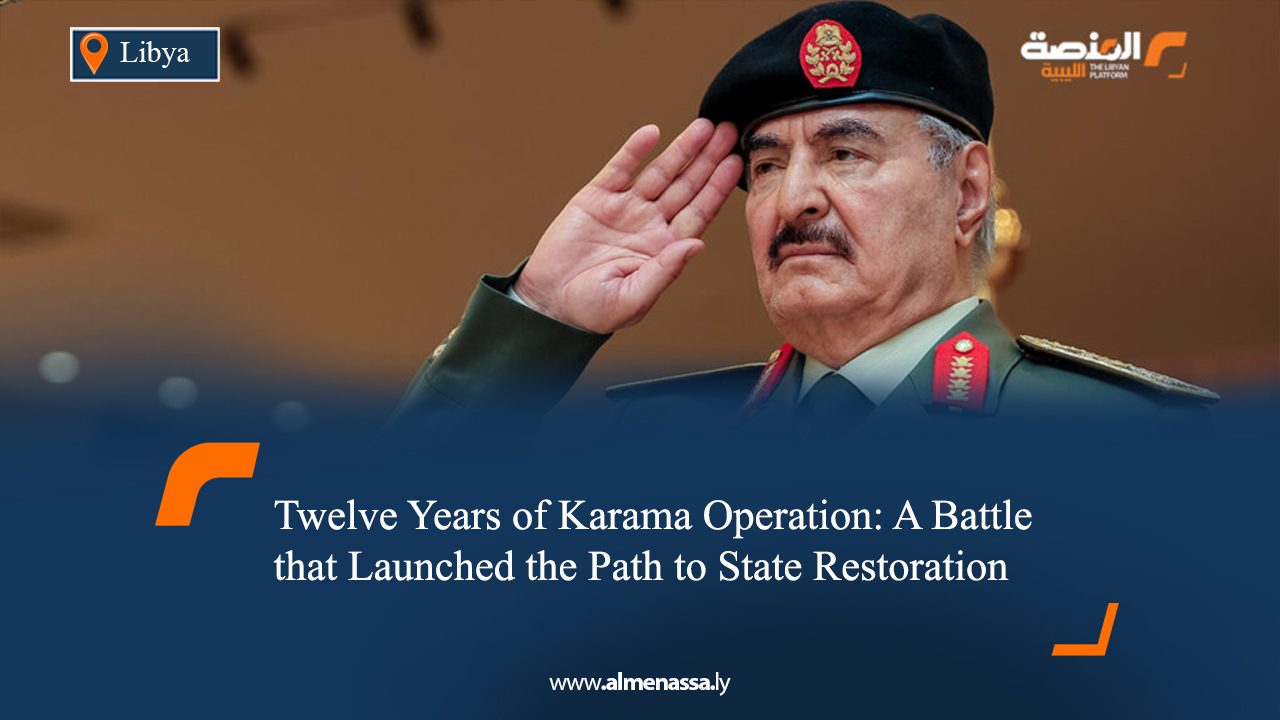
On May 16, Libya commemorates a defining milestone in its modern history—the 12th anniversary of Operation Karama (Dignity), launched by the Commander-in-Chief of the Armed Forces, Field Marshal Khalifa Haftar, in 2014. This intervention came at a time when the nation was grappling with the expansion of extremist groups and the collapse of state institutions. Twelve years later, this operation is still remembered as a crucial turning point that reshaped the security and military landscape, paving the way for a protracted campaign by the armed forces across several cities, most notably Benghazi and Derna, to reclaim the state, enforce security, and lay the foundations for a new era of stability.
The Onset of the War on Terror
In the spring of 2014, Libya was experiencing one of its most turbulent phases, marked by systematic assassinations, bombings rocking its streets, and kidnappings and intimidation targeting civilians and military personnel alike.
Amid this grim reality, the Commander-in-Chief, Field Marshal Khalifa Haftar, announced the launch of Karama Operation —a military movement aimed at rebuilding the military institution and eliminating terrorist organizations that sought to turn Libya into a launchpad for chaos and extremism in North Africa.
The operation came in response to growing popular demands, signaling the start of a long battle to restore the state’s authority and prestige.
Decisive Battles: From Benghazi to Derna
Military operations began in Benghazi city, which had become a stronghold for several extremist organizations. The armed forces engaged in fierce battles that lasted for years before officially announcing the complete liberation of the city from the grip of extremist groups on July 5, 2017.
Following this, operations shifted toward Derna, which was under the control of militant groups linked to al-Qaeda and extremist shura councils. The armed forces successfully established control over the city and restored state institutions.
The campaigns also extended to Libya’s southern regions, including cities like Sabha and Murzuq, with the objective of securing borders and pursuing armed factions and mercenaries who had exploited the security vacuum to control smuggling routes and vital resource sites.
Rebuilding the Military Institution
One of the most prominent outcomes of the Karama uprising was the reconstruction of the Libyan National Army and the consolidation of various military factions under a unified, regular command.
In the years following the launch of the operation, the General Command of the Armed Forces worked on reorganizing the military institution according to modern structures, focusing on training, discipline, and building a security framework capable of addressing contemporary threats.
Additionally, several security agencies that had vanished or weakened after the events of 2011 were reactivated, contributing to the restoration of stability across numerous cities and regions.
An Era of Reconstruction and Development
With security restored in the eastern and southern cities, a new phase commenced, focusing on reconstruction and the launching of development projects.
Cities like Benghazi, Derna, and Sirte witnessed the execution of extensive infrastructure rebuilding projects, which included constructing bridges and roads, as well as rehabilitating schools, universities, and public service facilities.
Development programs were also initiated in the agriculture, transport, and energy sectors, alongside projects to repair highways and establish new traffic axes connecting cities, as part of efforts to stimulate the economy and revive communities devastated by years of conflict.
Twelve years after its inception, observers view the Karama Operation as a major turning point in modern Libyan history, having successfully confronted extremist organizations and restored the military’s role in protecting the state.
It also marked the beginning of a new trajectory aimed at reclaiming state institutions and consolidating stability, even as the country continues to face political and security challenges that demand ongoing efforts to build a unified state capable of fulfilling the aspirations of Libyans.
The memory of May 16 remains a landmark in contemporary Libyan history, recalling a decisive phase of struggle against terror and chaos. More than a decade since its launch, Karama Operation is still invoked as a crucial juncture in the path to state restoration and the beginning of an era in which Libyans strive to solidify security and build a stable future